
For years, Pakistan’s local government system has remained a topic of debate — promises of devolution, conflicts over control, and constant legal changes. Now, with the introduction of the Punjab Local Government Act 2025, the discussion has returned to the center of attention.
Recently passed by the Punjab Assembly and officially notified by the provincial government, this law has stirred significant political and public reaction.
The government claims that the new law will strengthen local democracy and empower citizens. However, opposition parties argue that it violates Article 140-A of Pakistan’s Constitution, which guarantees administrative, financial, and political authority to elected local representatives.
Ordinary citizens, too, are wondering — will this new act truly bring governance closer to the people, or is it another political maneuver to centralize power?
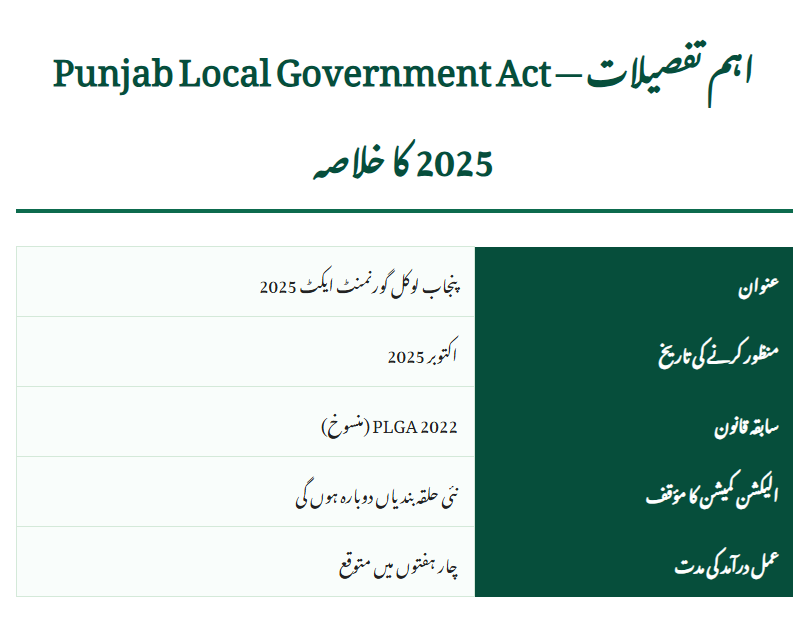
Quick Overview — Key Details of Punjab Local Government Act 2025
| Category | Details |
|---|---|
| Law Name | Punjab Local Government Act 2025 |
| Approved | October 2025 |
| Replaces | PLGA 2022 (Repealed) |
| ECP’s Action | Fresh delimitation to begin |
| Implementation Period | Four weeks requested by Punjab Govt |
Will Punjab Local Government Act 2025 Delay Local Elections?
That’s the question everyone in Punjab is asking.
The Election Commission of Pakistan (ECP) had started the delimitation process under the PLGA 2022 on October 9, aiming to hold local elections by the end of December 2025.
However, as soon as the new Punjab Local Government Act 2025 was notified, the ECP withdrew all earlier orders related to the 2022 law — including delimitation committees and administrative boundaries.
This effectively means the entire process must start again from scratch.
Although the ECP hasn’t officially stated that elections are delayed, it’s clear that fresh delimitations will likely push the election timeline further.
Why Is the Opposition So Critical of Punjab Local Government Act 2025?
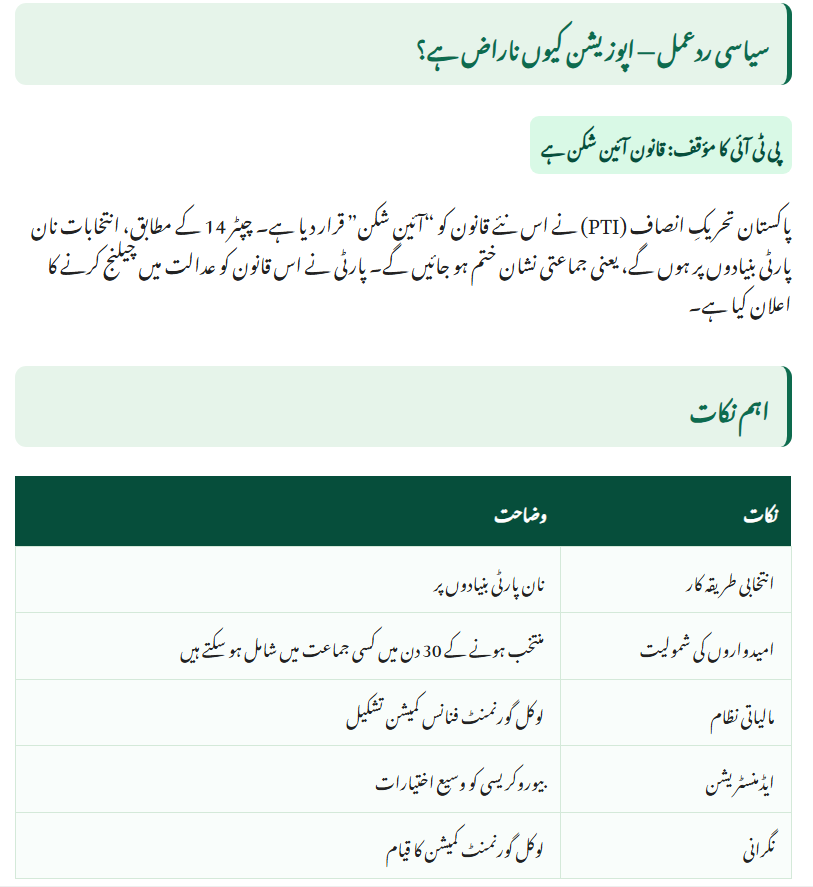
The Pakistan Tehreek-e-Insaf (PTI) and other opposition parties have strongly opposed the new law.
Their primary concern is that under the Punjab Local Government Act 2025, elections will be held on a non-party basis — meaning no political symbols or affiliations during voting.
PTI claims this move is designed to sideline political representation, especially after the party lost its election symbol.
The opposition also says the law goes against democratic principles and plans to challenge it in court.
They fear that without political identity, independent candidates could be pressured to join the ruling party once elected.
Main Features of Punjab Local Government Act 2025
| Feature | Explanation |
|---|---|
| Election Type | Non-party basis |
| Political Affiliation | Elected members can join a party within 30 days |
| Financial Setup | Local Government Finance Commission created |
| Administrative Role | Bureaucracy given expanded authority |
| Oversight | Establishment of Local Government Commission |
Will Non-Party Elections Weaken Democracy?
Experts are divided on this.
Critics say that non-party elections will lead to a lack of accountability and transparency. Without a party affiliation, voters won’t know what policies or principles their local candidates stand for.
On the other hand, the government argues that independent local elections will help empower communities by keeping politics out of grassroots governance.
In reality, the success or failure of this system will depend on how fairly it’s implemented and whether it genuinely improves public service delivery.
Why Has Bureaucratic Power Increased in the New Law?
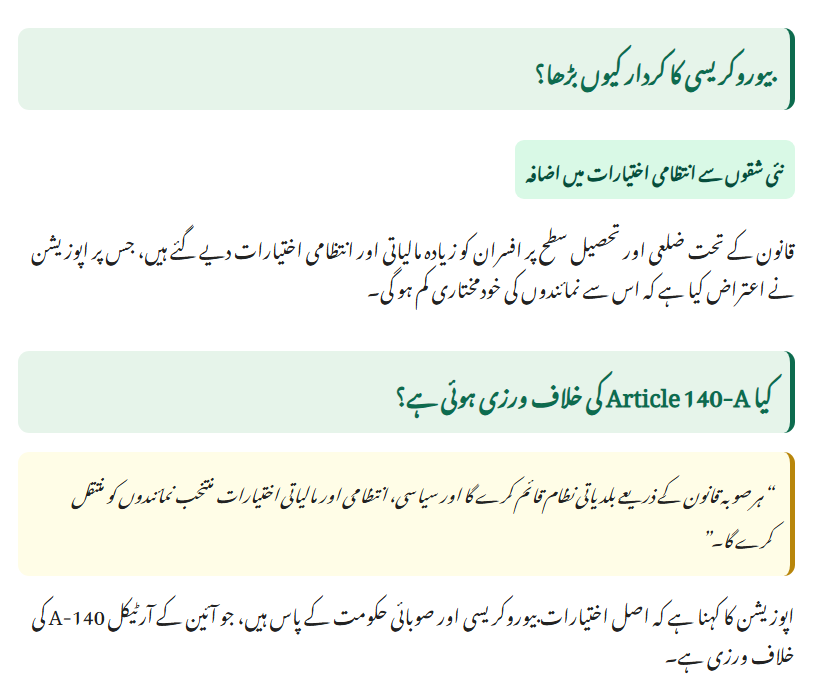
The Punjab Local Government Act 2025 gives significant administrative and financial powers to civil bureaucrats at the district and tehsil levels.
Two new entities — the District Municipal Coordination Forum and Joint Authorities — will have bureaucrats playing a central role.
This setup has raised alarms among opposition leaders, who argue that elected representatives will lose control over local decisions.
However, government officials insist that bureaucratic involvement ensures continuity, efficiency, and transparency in local governance.
Is Punjab Local Government Act 2025 Against Article 140-A of the Constitution?
Article 140-A of the Constitution states:
“Each province shall, by law, establish a local government system and devolve political, administrative, and financial responsibility and authority to the elected representatives of the local governments.”
Opposition parties argue that the Punjab Local Government Act 2025 does the opposite — transferring much of that power to the provincial government and bureaucracy rather than to elected councils.
If proven true, this could become a major constitutional issue and a subject of court intervention in the coming months.
New Local Government Commissions — Reform or Centralization?
The Act establishes two new commissions:
- Local Government Commission
- Local Government Finance Commission
These commissions will be overseen by senior ministers and secretaries from the Local Government and Finance Departments, giving them significant administrative authority.
While the government says this structure will ensure financial discipline and better oversight, critics argue that it centralizes power and undermines the independence of local councils.
How Will Punjab Local Government Act 2025 Affect Ordinary Citizens?
For the average citizen, laws only matter if they improve daily life.
If this new act helps deliver clean water, waste management, repaired roads, healthcare, and education, people will consider it a success.
But if it merely adds more bureaucracy and delays, public trust in local institutions will decline even further.
The key lies in how well power is actually devolved — whether decisions about neighborhoods are made by local representatives or by distant provincial offices.
Political Outlook — Reform or Instability Ahead?
Analysts believe that the Punjab Local Government Act 2025 could either stabilize the local governance system or deepen political polarization.
If elections are delayed or legally challenged, Punjab might see another phase of political uncertainty.
The only sustainable path forward is for all stakeholders — the ECP, government, and opposition — to work together and ensure a system that is constitutional, transparent, and accountable to the people.
Conclusion — Reform or Reversal?
The Punjab Local Government Act 2025 is being hailed by the government as a step toward reform, but many fear it’s a step backward in democratic devolution.
True reform will only happen if authority genuinely moves from the provincial level to local elected representatives, not just on paper.
If implemented fairly, the Act could strengthen democracy; if not, it risks becoming another chapter in Pakistan’s long struggle for local empowerment.
For official details, visit the government’s website:
👉 https://lgcd.punjab.gov.pk
Frequently Asked Questions (FAQs)
1. What is the Punjab Local Government Act 2025?
It’s the new law passed by the Punjab government to regulate local bodies, replacing the PLGA 2022.
2. Will local elections in Punjab be delayed because of this Act?
While the ECP hasn’t officially announced a delay, new delimitations under the 2025 law will likely push elections beyond December 2025.
3. Why is the opposition against the Punjab Local Government Act 2025?
The opposition says the Act violates Article 140-A and eliminates party-based elections, weakening democracy.
4. How will this law affect local representatives?
Local representatives may have less control over finances and administration since bureaucrats are given expanded powers.
5. What does the government claim about the new law?
The Punjab government says the Act will make governance more efficient and reduce political interference at the local level.