
BISP Cash Transfers And IPV
The Benazir Income Support Programme (BISP) has long been a lifeline for millions of vulnerable households in Pakistan. Not only do BISP cash transfers reduce poverty, but they also help strengthen women’s independence, reduce household tension, and have been linked with lower rates of intimate partner violence (IPV). But what will happen if these payments are suddenly stopped in 2026? Below we explore the potential impacts on families, women’s safety, and social stability. Information here draws from the official BISP website
| Aspect | Key Detail |
|---|---|
| Program Name | Benazir Income Support Programme (BISP) |
| Main Benefit | Quarterly cash transfers to low‑income women |
| Primary Goal | Poverty reduction and empowerment |
| IPV Link | Reduced intimate partner violence |
| Sudden Stop Risk | Increased financial stress & family conflict |
| Official Helpline | 0800‑26477 (Toll‑Free) |
| Payment Check | SMS to 8171 or online portal |
| Policy Advice | Gradual exit & support services |
What Is BISP and Why It Matters BISP Cash Transfers And IPV 2026 – Effects of Sudden Discontinuation
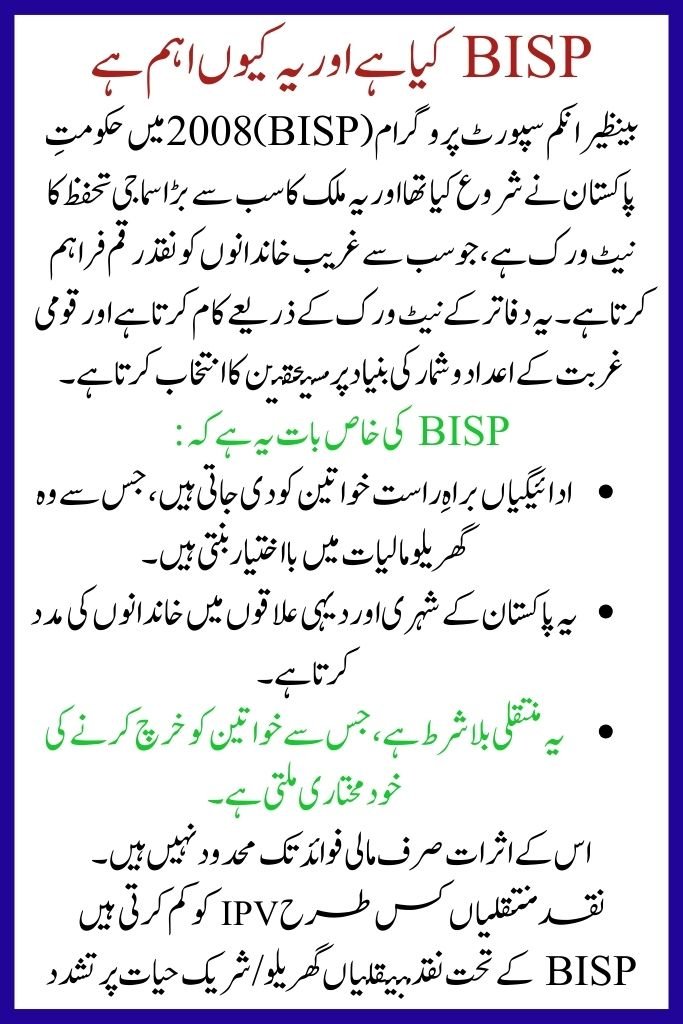
The Benazir Income Support Programme was launched by the Government of Pakistan in 2008 as the nation’s largest social safety net, targeting the poorest households with cash transfers. It operates through a network of offices and uses national poverty data to select beneficiaries.
BISP is distinct because:
- Payments go directly to women, empowering them in household finances.
- It supports families across urban and rural Pakistan.
- Transfers are unconditional, giving women autonomy in spending.
This has effects that reach beyond money.
How Cash Transfers Lower IPV BISP Cash Transfers And IPV 2026 – Effects of Sudden Discontinuation
Cash transfers under BISP work in powerful ways to reduce intimate partner violence:
- Reduced financial stress: Regular money helps meet food, health, and school expenses.
- Women’s empowerment: Having funds boosts confidence and decision‑making power.
- Better relationships: Fewer money fights improve household peace.
- Community respect: Women gain status when they contribute financially.
These benefits reinforce each other, contributing to more secure family environments.
Also Read ; Forgot Your PAVE Portal Password
The Risks of Suddenly Ending BISP Payments BISP Cash Transfers And IPV 2026 – Effects of Sudden Discontinuation
If BISP payments are abruptly cut in 2026, the gains made in women’s empowerment and reduced IPV could unravel. Below is a step‑by‑step look at likely impacts:
- Return to Financial Stress
- Families lose a steady source of support.
- Bills and food insecurity surge.
- Conflicts over money may restart.
- Loss of Women’s Power
- Women lose the financial role that improved their status.
- Decision‑making shifts back to others.
- Vulnerability to abuse rises.
- Increased Household Strain
- Scarce resources lead to more arguments.
- Tensions escalate into emotional or physical violence.
- Different Outcomes Across Families
- A few households with savings may cope.
- Most poor families have no safety buffer.
This pattern shows why cash withdrawals are more than a budget problem they affect safety and dignity.
How Discontinuation Links to IPV BISP Cash Transfers And IPV 2026 – Effects of Sudden Discontinuation
Research suggests several mechanisms by which stopping cash transfers increases IPV risk:
- Economic pressure: Poverty‑induced arguments return.
- Shifted power: Women lose influence without money.
- Psychological stress: Anxiety and hopelessness grow.
- Fading recognition: Respect earned through contribution diminishes.
Together, these create a higher likelihood of conflict and violence within the home.
Lessons From International Experience BISP Cash Transfers And IPV 2026 – Effects of Sudden Discontinuation
Worldwide research shows how effective cash transfer programs can be when done well. For example:
- Bangladesh: Nutrition‑linked transfers reduced IPV, with effects lasting beyond the program.
- Latin America: Cash linked to school attendance reduced household conflict.
- Sub‑Saharan Africa: Payments to women were more effective in lowering IPV than general household transfers.
Global lesson: The biggest impact comes when cash support is paired with empowerment, savings support, and social services.
What Can Be Done If Payments End BISP Cash Transfers And IPV 2026 – Effects of Sudden Discontinuation
If the government must stop payments, sudden ending is risky. These harm‑reduction strategies are safer:
- Gradual phase‑out — Give time for families to adjust.
- Encourage savings — Strengthen financial buffers.
- Skills training — Equip women for sustainable income.
- Support services — Counseling and financial literacy help.
- Clear communication — Reduces fear and uncertainty at home.
Such steps help preserve what has been gained from years of support.
Helpline & Contact BISP Cash Transfers And IPV 2026 – Effects of Sudden Discontinuation
If you need help with BISP payments, registration, or issues, here are official contacts:
- Toll‑Free Helpline: 0800‑26477 (Pakistan)
- Head Office Exchange: 051‑9246326 (Islamabad)
- SMS Service: Send your CNIC to 8171 to check status.
- Email: info@bisp.gov.pk (general queries)
- Regional Offices: Lahore: 042‑35219118; Multan: 061‑9330600; Faisalabad: 041‑2421309.
Always use official numbers and avoid sharing sensitive data with unknown agents.
Conclusion
The BISP Cash Transfers And IPV relationship shows that safety nets are more than financial buffers they promote empowerment and protect vulnerable women. Sudden discontinuation would not only push families back into poverty but also risk increasing intimate partner violence by reigniting stress and weakening women’s autonomy.
For policymakers in Pakistan, the message is clear: cash transfer programs should be sustained responsibly, paired with support services, and phased out gradually if needed. Only then can gains in poverty reduction and women’s safety be preserved.
Frequently Asked Questions
What exactly are BISP cash transfers?
BISP cash transfers are quarterly payments to low‑income households, primarily given to women to improve their financial stability.
How do I check my BISP payment status?
You can check payment status by sending your CNIC to 8171 or using the online portal.
Can stopping BISP really increase violence?
Yes — research shows that financial stress and loss of women’s autonomy can increase household tension and IPV risk.
Who should I call for BISP problems?
Call the toll‑free helpline 0800‑26477 or visit your nearest BISP tehsil office